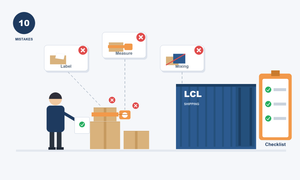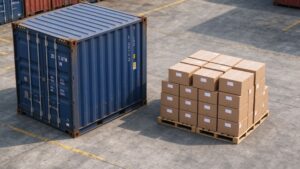
If your cargo fills only part of a container, LCL shipping lets you pay for the space you use. Instead of renting a whole 20ft or 40ft box, you share one with other importers. For a first shipment, samples, or a small product run, this is often the most practical way to start.
This guide explains how LCL shipping works, what it costs, how long it takes, and how to measure your cargo. For the full door-to-door picture, see the China-to-USA LCL overview.
Key Takeaways
If you are new to LCL shipping, start with these five points:
- LCL shipping means sharing a container. You pay for your own volume, not the whole box.
- It suits roughly 1 to 15 CBM. Above that, compare FCL; below it, a minimum charge usually applies.
- Ocean sailing is only one part of the timeline. CFS deconsolidation at the US end adds time that FCL does not.
- A quote has several lines: ocean freight, origin and destination handling, documents, clearance and delivery.
- Measure the outer carton size for an accurate CBM. Add a packing allowance only if packing is not final.
What is LCL shipping?
LCL stands for less-than-container-load. Your goods travel inside a shared ocean container with other shippers’ cargo. A forwarder groups several small shipments at origin, ships the container as one unit, then separates the shipments at destination.
The alternative is FCL, or full-container-load, where one importer books the entire container. LCL shipping exists because most first orders, samples, and early production runs do not fill a box. If you are weighing the two, the LCL vs FCL comparison breaks down the trade-off.
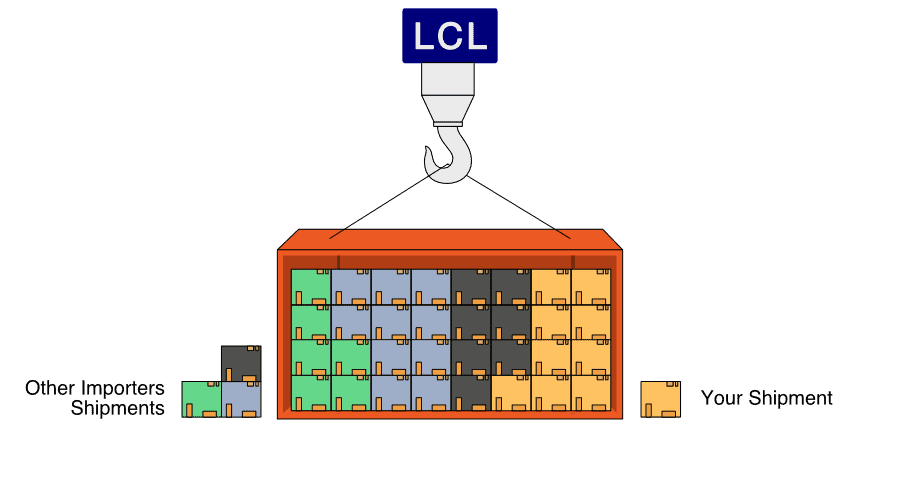
How does LCL consolidation work?
The process has six stages. Your cargo is delivered to a container freight station (CFS) in China. It is grouped with other boxes, loaded on a vessel, and unloaded at the US port. At the destination CFS it is separated, then cleared and delivered.
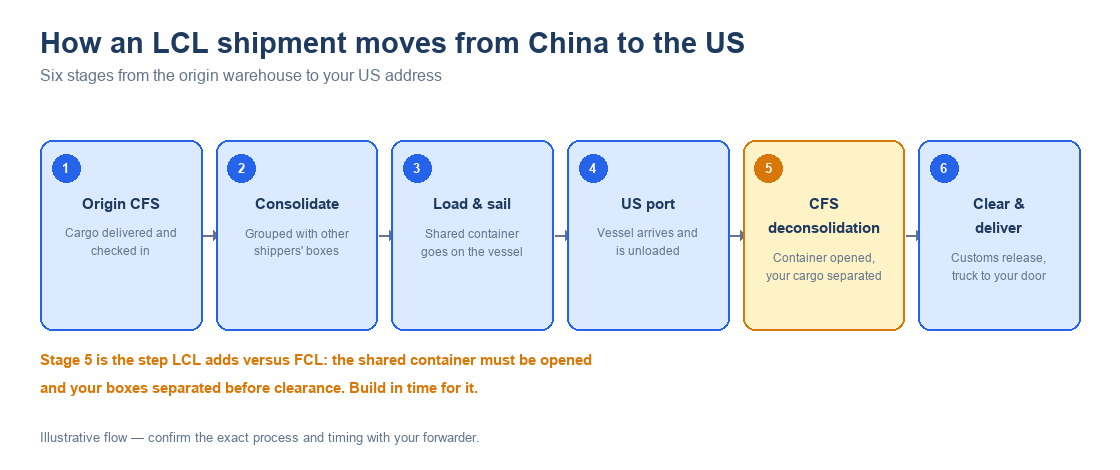
Stage five matters most for timing. In FCL, the container is sealed until it reaches your door or a yard. In LCL, the carrier opens it at a US CFS and sorts every shipper’s boxes. That deconsolidation queue can add days, especially in peak season.
Because many shippers share the container, LCL shipping costs are split. You pay for your own volume, not the whole box.
When should you choose LCL shipping?
LCL shipping suits shipments of roughly 1 to 15 CBM. Below that, a full container wastes most of its space. Above roughly 15 to 18 CBM, FCL often costs less per unit. Compare both options on your real volume.
| Situation | Better fit |
|---|---|
| 1 to 15 CBM of general cargo | LCL |
| Samples or a first test order | LCL |
| Fragile or mixed goods in small volume | LCL |
| More than 15 to 18 CBM | Compare LCL and FCL |
| A full container of one product | FCL |
LCL also fits buyers who want smaller, more frequent batches. It helps test a new market before committing to container volumes, and it keeps cash tied up in each shipment lower.
What do you pay for in LCL shipping?
A typical China-to-US quote has several lines. Reading each one helps you compare ocean quotes fairly instead of looking only at the $/CBM number.
| Charge | What it covers |
|---|---|
| Ocean freight | Core sea freight based on chargeable volume or weight, subject to minimum CBM |
| Origin handling | Consolidation, receiving and CFS handling at the warehouse in China |
| Documentation | Bill of lading and export paperwork |
| Destination handling | Deconsolidation, devanning and CFS handling at the US arrival side |
| Customs clearance | Broker filing for US import entry |
| Final delivery | Trucking from the CFS or release point to your address |
Most forwarders price LCL shipping by cubic meter. Even a load below 1 CBM is usually accepted, but billing applies a minimum of roughly 1 CBM. See the LCL cost breakdown for how each line is calculated.
US import entry is filed with Customs and Border Protection rules in mind. Ask your broker what documents your commodity needs before the vessel arrives.
How long does LCL take from China to the US?
Ocean sailing to the US west coast typically runs 12 to 16 days. East coast all-water services take roughly 30 to 35 days. These are sailing times, not door-to-door totals.
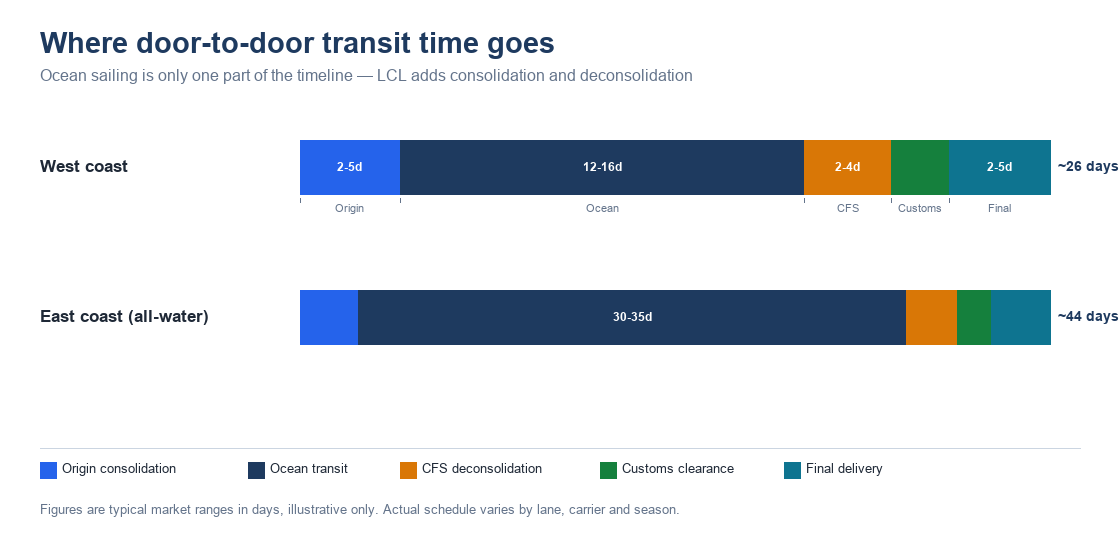
For a full LCL shipping timeline, add origin consolidation, CFS deconsolidation at destination, customs clearance and final trucking. A west coast move can take around 3 to 4 weeks door to door; an east coast all-water move often runs 5 to 6 weeks.
These ranges are typical market figures, not guaranteed schedules. Your forwarder confirms an actual vessel schedule when you book.
How do you estimate your cargo volume?
Freight is priced on cubic meters, so an accurate estimate matters from the start. Measure each carton in centimeters and apply this formula:
Length x Width x Height x carton count, divided by 1,000,000, equals total CBM.
For example, ten cartons of 60 x 40 x 40 cm come to 0.96 CBM. Use the outer carton dimensions once packing is final. If cartons are not packed yet, or you plan to palletize, confirm the pallet and packing allowance with your forwarder rather than adding a fixed percentage on your own.
A correct figure at the quoting stage avoids invoice adjustments later.
How do you get started with LCL?
A first LCL shipment follows five steps:
- Measure your cartons and work out the volume in CBM, using the method above.
- Prepare the basic documents: commercial invoice, packing list, and buyer and seller details.
- Ask for a quote with a clear breakdown of charges.
- Book space and confirm the cargo cut-off date.
- Deliver your cargo to the consolidation warehouse on time.
One forwarder can handle consolidation, documents and the US side, so you manage a single point of contact instead of coordinating carriers, warehouses and brokers yourself.
What LCL terms will you hear?
Forwarders use a handful of terms that are worth knowing before your first shipment.
| Term | Meaning |
|---|---|
| CFS | Container freight station, the warehouse where LCL cargo is consolidated at origin and deconsolidated at destination |
| Cut-off | The deadline for your cargo to reach the warehouse for a given sailing |
| Chargeable volume | The CBM basis your freight is billed on, set by volume or weight and minimum rules |
| House bill of lading | The document your forwarder issues for your share of the container |
| Roll | When cargo misses its vessel and moves to a later sailing |
| Demurrage | Charges when a container stays at the port or terminal past its free time; LCL boxes held at the destination CFS may also incur storage fees |
Demurrage and detention are distinct. Demurrage applies while the container sits at the terminal. Detention applies after it leaves the terminal and comes back late.
For LCL cargo, late pickup at the destination CFS usually produces a storage charge on your boxes, not a container charge. These terms make a quote and a bill of lading easier to read.
How USLCL Handles This
- We consolidate China-to-US LCL cargo for shipments from roughly 0.5 CBM upward, with a minimum charge of about 1 CBM.
- One point of contact from factory pickup to US delivery, with a clear quote before you book.
- Export documents, consolidation, ocean freight and US customs coordination handled for you.
- Options for port pickup or door delivery, so you choose the service level that fits your budget.
Ready to move your cargo? Prepare a freight inquiry and our team will confirm space and timing for your shipment.
Frequently Asked Questions
Is LCL cheaper than FCL?
For small shipments, yes. LCL avoids paying for unused container space, so it is usually cheaper below roughly 15 CBM. Above that, FCL typically gives a lower cost per cubic meter. Your volume, frequency and delivery needs decide the winner.
What is the minimum cargo size for LCL?
Most forwarders accept cargo from a few boxes upward, even around 0.5 CBM. Billing usually applies a minimum of about 1 CBM. A small first sample can move by LCL, though the per-unit cost is higher than a fuller load.
Why does LCL take longer than FCL?
LCL adds two steps. Your boxes wait at the origin CFS to be grouped, then sit in a deconsolidation queue at the destination CFS before clearance. FCL skips both, so it often arrives sooner.
Who consolidates my cargo with others?
Your freight forwarder does. They group compatible shipments at a warehouse or CFS in China, then manage the container as one unit to the destination port.
Can LCL cargo go door to door?
Yes. Many forwarders truck the cargo from the port or CFS to your US address after clearance. Door service adds a trucking charge but removes the need to arrange pickup yourself.