Ask three forwarders for a China-to-US LCL rate and you may see $45, $90 and $137 per CBM. The shipments can look identical. None of the quotes needs to be wrong.
They may simply price different things. This guide shows how a quote is built, which charges sit outside the headline rate, and the seven checks to run before you compare two numbers.
Key Takeaways
If you remember nothing else, keep these five points:
- Chargeable CBM, not carton count, sets your bill. The W/M rule picks the greater of volume or weight.
- US inland cargo often converts at 1 CBM = 363 kg to 500 kg, not the 1,000 kg used at base ports. Ask which ratio applies.
- The advertised $/CBM usually covers ocean freight alone. Origin, US arrival and final delivery are separate groups.
- Compare the total delivered to your US ZIP code, never the headline rate.
- At 12–15 CBM, also price a 20ft container. It may cost less per CBM.
How LCL Charges Are Calculated (W/M Rule)
LCL cargo shares a container with other shippers. Space, not weight, usually sets the price. Most carriers price by cubic metre (CBM) under the weight-or-measure (W/M) rule.
Chargeable quantity = the greater of actual volume (CBM) or weight converted at the lane’s ratio.
Standard ocean LCL often uses 1 CBM = 1,000 kg. China-to-US cargo frequently uses a tighter ratio — 1 CBM = 363 kg to 500 kg. US road weight limits drive this, especially for cargo moving inland beyond the port.
Under a 1:500 ratio, a 2.5 CBM shipment at 1,600 kg bills as 3.2 CBM. The same volume at 800 kg bills at 2.5 CBM. Dense cargo pays on weight; light, bulky cargo pays on volume. Confirm the exact ratio on your quote.
| Service / destination | Typical W/M ratio | Effect on dense cargo |
|---|---|---|
| China to US base port (LA, Long Beach, NY) | 1 CBM = 1,000 kg | Weight converts loosely; volume usually wins for light cargo |
| China to US inland point (IPI) | 1 CBM = 363 kg or 500 kg | Weight converts tightly; dense cargo bills at a higher CBM |
| Any lane, written quote | Forwarder-specific | Only the stated ratio is safe to compare |
Calculating your CBM before a quote
Measure each carton’s outer dimensions in metres. Multiply length × width × height, then multiply by the carton count.
Example: 10 cartons at 80 × 60 × 50 cm give 0.8 × 0.6 × 0.5 = 0.24 CBM each, or 2.4 CBM in total. Apply the W/M rule after you have the volume.
For palletised cargo, state the pallet count and outer pallet size. Forwarders may bill pallet bases differently. Careful measurements beat any rate negotiation.

The Four Charge Groups of a China-to-US LCL Shipment
Every complete LCL move has four groups. A quote that names one group is a component, not a price.
1. China origin charges
These cover receiving and CFS handling, export documents, export customs coordination and consolidation into the shared container.
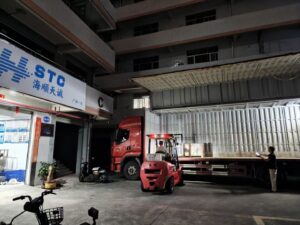
Cargo delivered to a forwarder warehouse, such as our Guangzhou or Shenzhen receiving, should show intake as a clear line item. Ask what triggers extra charges: storage past the free window, repacking, labelling or inspection.
2. Ocean freight
This is the $/CBM headline. It may carry bunker and peak-season surcharges, and it always carries a validity period.
Rates move weekly. A number without a validity date is incomplete. Small shipments also face a minimum charge.
3. US destination charges
After arrival, expect deconsolidation (unpacking the shared container) and destination CFS handling. You will also see documentation, port and infrastructure surcharges such as PierPass or chassis fees, customs entry, and CBP examination costs if selected.
Mandatory filings sit here too. ISF 10+2 and AMS are required on US-bound ocean cargo. CBP requires ISF at least 24 hours before loading at the origin port, not after arrival. Ask who files each one and what the fee covers.
| US-side line item | What it covers | When it is due |
|---|---|---|
| Deconsolidation / destination CFS | Unpacking the shared container and handling your cargo | After arrival |
| PierPass (LA/LB) / chassis fee | Port traffic mitigation and container chassis use | After arrival, at port or drayage |
| Customs entry | Broker filing and entry documents | Before cargo release |
| ISF 10+2 and AMS | Cargo security filings to CBP | At least 24h before loading at origin (both ISF and AMS) |
| CBP examination | Exam and handling if the shipment is selected | After arrival, if selected |
4. Final delivery
This covers trucking from the release point to your address: local trucking or LTL, delivery appointments, liftgate where needed, and residential surcharges.
Port-to-port and door quotes differ by this whole group, plus part of group 3. Normalise scope before you compare numbers.

LCL vs. FCL: When to Switch to a Full Container
The costliest LCL decision is staying in LCL too long. A 20ft container holds about 28 CBM of practical cargo space.
As chargeable volume reaches the low-to-mid teens, a full container can cost less per CBM. It also removes deconsolidation and its wait.
| Chargeable volume | Typical planning stance | Why |
|---|---|---|
| 1–5 CBM | LCL is the natural fit | You pay only for the space you use |
| 6–12 CBM | LCL usually still works | Price an FCL comparison if cargo is dense or time-sensitive |
| 12–15+ CBM | Always price both | The current FCL market, not a fixed rule, decides the winner |
Our LCL vs FCL guide covers the operational trade-offs beyond price.
The 7-Point Quote-Comparison Checklist
Put two China-to-US LCL quotes side by side. Confirm all seven points in writing:
- Chargeable quantity: same CBM, same W/M ratio, same minimum?
- Origin group: which handling, document and customs items are included?
- Ocean: surcharges listed separately? Validity date stated?
- Destination group: deconsolidation and handling shown per CBM and per shipment?
- Customs: whose broker, and are duties and taxes in or out?
- Delivery: to the release point, or to a named ZIP with appointment?
- Exclusions: is the list written down, not implied?
If a forwarder cannot answer all seven in writing, the price gap is not a saving. It is an unpriced risk.
Get an Itemised, Comparable Quote
Every US LCL quote from us breaks down the same four groups. It states exclusions and carries a validity period. Service scope and availability are confirmed for each shipment.
Send the commodity, carton dimensions, gross weight, origin port and US delivery ZIP. Add pallet dimensions for palletised cargo. We will return an itemised number you can compare line by line.
Frequently Asked Questions
Why do two LCL quotes for the same China-to-US shipment differ so much?
They often price different scopes. A $45/CBM rate may cover ocean freight only. A $137/CBM rate may include origin handling, US deconsolidation and delivery. Normalise all four charge groups before you compare the numbers.
What does 1 CBM = 363 kg mean on a China-to-US quote?
It is the weight-to-volume ratio the forwarder uses to convert dense cargo into revenue tons. At 1:363, 1,000 kg converts to about 2.75 CBM. US inland points often use 1:363 or 1:500. Base ports commonly use 1:1,000.
Is ISF 10+2 a destination charge?
The filing is not. US Customs requires ISF at least 24 hours before cargo loads at the origin port. The filing fee may appear on your US-side invoice, but the obligation and deadline sit before sailing. Late or inaccurate filings can draw a $5,000 penalty.
Which charges appear after my cargo reaches the US?
Expect deconsolidation, destination CFS handling, documentation, customs entry, port or infrastructure surcharges such as PierPass and chassis fees, and CBP examination costs if the shipment is selected. Ask for each as a line item.
At what volume should I switch from LCL to FCL?
Price both once chargeable volume reaches 12 to 15 CBM. A 20ft container holds roughly 28 CBM of practical space. A partly empty container can still beat LCL per CBM, and it avoids deconsolidation and its wait.
What details should I send for an accurate LCL quote?
Send the commodity, carton dimensions, gross weight, origin port and US delivery ZIP code. Add pallet dimensions for palletised cargo. With those details, a forwarder can state chargeable CBM and itemise all four charge groups.
Related Reading
LCL shipping guide → · Documents for an LCL shipment → · Transit time breakdown →